
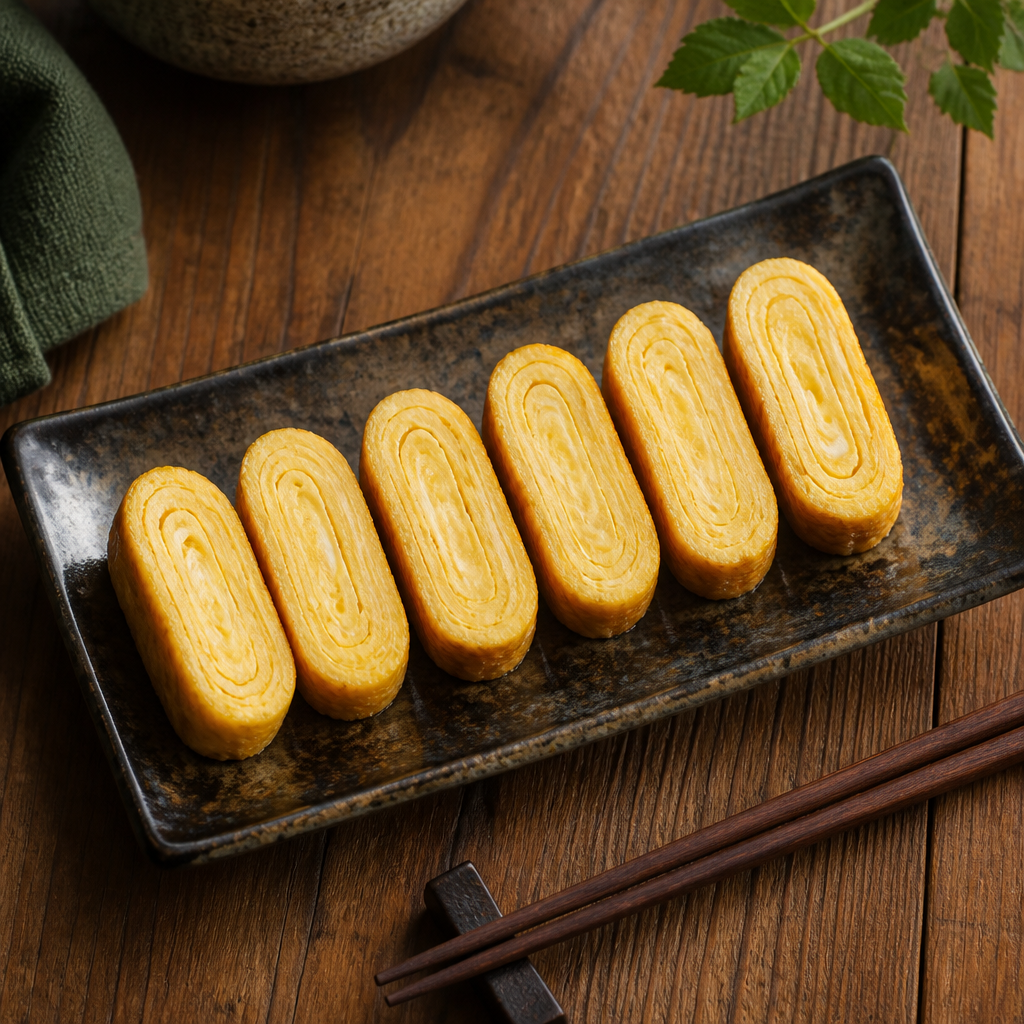
Japanese Tamagoyaki (Sweet Rolled Omelet)
shared by המטבח של Nibblore
Tamagoyaki is a tender Japanese rolled omelet made from delicate layers, with a balanced sweet-and-savory flavor. A small amount of dashi adds depth without making the egg mixture too runny, so it remains easy to roll. Serve it warm or at room temperature as part of a Japanese meal or packed into a bento box. • Keep the heat at medium: an overly hot pan creates brown patches and a scorched egg flavor, while a pan that is too cool makes rolling difficult. • Straining the mixture removes strands of egg white and gives the omelet a smoother, more even texture. • If a layer tears, keep rolling; the next layer will cover the tear and hold the omelet together. • You can use the same method with a 20 cm round frying pan, but fold the edges slightly inward with each roll to create a neat shape. • Replace the dashi with 2 tablespoons water for a milder flavor. • Replace the mirin with 1 teaspoon water mixed with an additional 1/4 teaspoon sugar. • Replace the tamari with regular soy sauce, but the dish will no longer be gluten-free. • For a less sweet tamagoyaki, reduce the sugar to 1 teaspoon without changing the other quantities. Cool completely and refrigerate in an airtight container for up to 2 days. Serve cold or at room temperature; to reheat, cover and microwave on medium power for only 20–30 seconds to prevent drying. Freezing is not recommended because the texture becomes spongy.
- Total time
- 20 min
- Servings
- 2
- Difficulty
- Intermediate
Create a free account to keep this recipe in your own cookbook and find it again when it’s time to cook.
Save to my cookbook — freeIngredients
- 4large eggs
- 2 tbspdashi stock, chilled
- 2 tspgranulated sugar
- 1 tspgluten-free tamari
- 1 tspmirin
- ⅛ tspfine salt
- 2 tspneutral vegetable oil, plus more for greasing as needed
Instructions
- 1In a small bowl, stir together the dashi, sugar, tamari, mirin, and salt until the sugar dissolves. Add the eggs and gently whisk with a fork or chopsticks just until evenly combined; avoid incorporating excess air. Strain through a fine-mesh sieve into a container with a pouring spout.
- 2Heat a rectangular 15 × 20 cm tamagoyaki pan over medium heat for 2 minutes. Drip in a little egg mixture; if it sets within 2–3 seconds without browning, the pan is ready. Using tongs, dip a piece of paper towel in the oil and lightly grease the pan.
- 3Pour about one-quarter of the egg mixture into the pan and immediately tilt it to cover the base in an even layer. Pop any large bubbles with chopsticks. Cook for 30–45 seconds, until the layer is almost set but still slightly glossy on top.
- 4Using a thin spatula, fold the omelet from the far side toward you in three or four folds, forming a roll at the near edge. Push the roll back to the far side of the pan.
- 5Grease the pan again, including the area beneath the roll. Pour in another quarter of the egg mixture and tilt the pan, gently lifting the roll so the uncooked egg flows underneath it. Cook for 30–45 seconds, until almost set, then roll the omelet toward you so the new layer wraps around it.
- 6Return the roll to the far side and repeat the greasing, pouring, and rolling process twice more with the remaining mixture. Reduce the heat to medium-low if the omelet browns before each layer sets. After the final roll, cook it on each side for 15–20 seconds to set and shape it.
- 7Transfer the tamagoyaki to a sushi mat or a sheet of parchment paper, wrap it gently, and shape it into a rectangular roll. Let it set for 3 minutes, then unwrap and use a sharp knife to cut it into 6 even slices. Serve warm or at room temperature.