
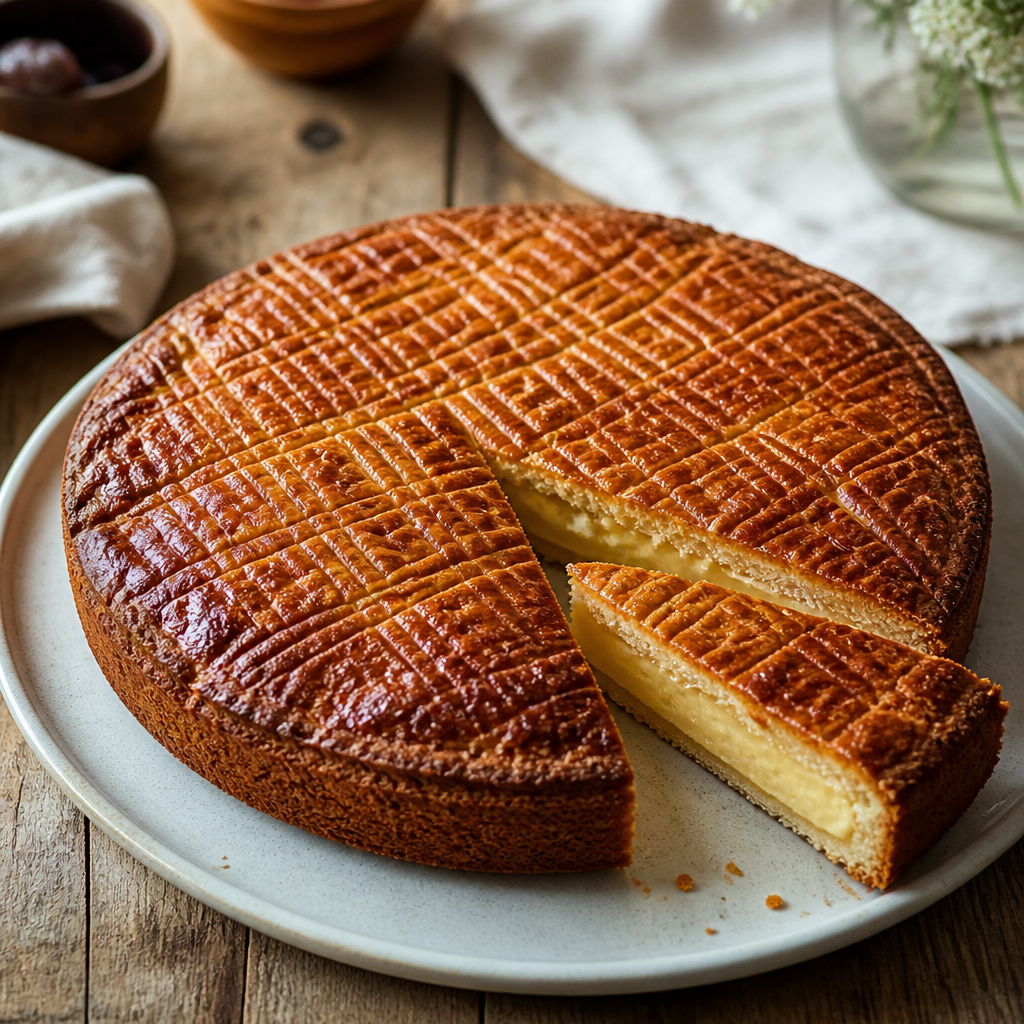
Traditional Basque Cake with Vanilla Pastry Cream
shared by Nibblore Cuisine
This classic gâteau Basque pairs tender, lemon-scented shortcrust pastry with a thick, velvety vanilla pastry cream. Chilling both the filling and the dough makes assembly easier and produces clean slices. Make it a day ahead to let the flavors and textures settle beautifully. • Weigh the two portions of dough to ensure the base is thick enough and the top is slightly thinner. • If the dough softens during assembly, refrigerate it for 10 minutes before continuing. • The pastry cream must be completely cold before assembly, or it will soften the dough and may leak during baking. • For clean slices, wipe the knife blade between cuts. • Replace the dark rum with 20 ml milk and 1 teaspoon vanilla extract without changing the pastry's texture. • If vanilla beans are unavailable, use 2 teaspoons natural vanilla extract and stir it into the cooked pastry cream off the heat. • Replace the lemon zest with the finely grated zest of half an unwaxed orange. Store the cake covered in the refrigerator for up to 3 days, then let it stand at room temperature for 30 minutes before serving. Freeze the whole cake or individually wrapped slices for up to 1 month; thaw overnight in the refrigerator. Reheating is not recommended because it may liquefy the pastry cream.
- Total time
- 95 min
- Servings
- 8
- Difficulty
- Intermediate
Create a free account to keep this recipe in your own cookbook and find it again when it’s time to cook.
Save to my cookbook — freeIngredients
- 300 gall-purpose flour
- 6 gbaking powder
- 2 gfine salt
- 170 gunsalted butter, softened
- 145 ggranulated sugar
- 1unwaxed lemon, finely grated zest
- 1egg, at room temperature
- 2egg yolks, at room temperature
- 20 mldark rum
- 400 mlwhole milk
- 1vanilla bean, split and scraped
- 70 ggranulated sugar
- 4egg yolks
- 35 gcornstarch
- 15 gunsalted butter
- 1egg, beaten for egg wash
Instructions
- 1Make the pastry: combine the flour, baking powder, and salt in a mixing bowl. In a separate bowl, beat the 170 g butter, 145 g sugar, and lemon zest for 2 minutes, until smooth and creamy; do not incorporate too much air.
- 2Mix the egg, 2 egg yolks, and rum into the butter mixture. Add the dry ingredients and mix only until no visible flour remains. Divide the dough into two portions, approximately 60% and 40%. Flatten each into a disk, wrap, and refrigerate for 1 hour.
- 3Meanwhile, make the pastry cream: pour the milk into an 18–20 cm saucepan and add the vanilla seeds and pod. Heat over medium heat until it just begins to simmer, then remove from the heat and infuse for 10 minutes.
- 4Whisk the 70 g sugar with the 4 egg yolks for 30 seconds, then whisk in the cornstarch. Remove the vanilla pod and gradually whisk half the hot milk into the yolk mixture. Pour everything back into the saucepan with the remaining milk.
- 5Cook the pastry cream over medium-low heat, whisking constantly. Once it thickens and begins to bubble, cook for 1 minute more to remove the raw taste of the cornstarch. Remove from the heat and stir in the 15 g butter. Spread the cream in a shallow dish, press plastic wrap directly onto the surface, cool for 20 minutes at room temperature, then refrigerate for 40 minutes.
- 6Preheat the oven to 175°C conventional, or 165°C fan. Lightly butter a 22 cm round cake pan, preferably with a removable base, and line the bottom with a circle of parchment paper.
- 7Place the larger portion of dough between two sheets of parchment paper and roll it into a disk about 29 cm across and 5 mm thick. Remove the top sheet, invert the dough into the pan, and peel away the remaining sheet. Gently press it over the bottom and up the sides to form a 3 cm rim, patching any cracks with small pieces of dough.
- 8Briefly whisk the cold pastry cream to loosen it without making it runny. Spread it over the pastry base, leaving about 1 cm clear around the top edge, then smooth the surface.
- 9Roll the smaller portion of dough between two sheets of parchment paper into a 23 cm disk. Remove one sheet, invert the dough over the pastry cream, and peel away the second sheet. Carefully seal the top to the bottom pastry rim with your fingers, then trim any excess.
- 10Brush the surface lightly with beaten egg. Use the tines of a fork to score a crosshatch pattern without piercing the pastry, then make a small 3 mm vent hole in the center to release steam.
- 11Bake on a rack in the lower third of the oven for 40–45 minutes, until evenly golden brown and firm in the center when gently touched. If the surface browns too quickly, loosely cover it with aluminum foil for the final 10 minutes.
- 12Cool the cake in its pan for 30 minutes, then carefully remove it and transfer it to a wire rack. Wait at least 3 hours before slicing so the pastry cream can set and the crust can develop its tender texture.