
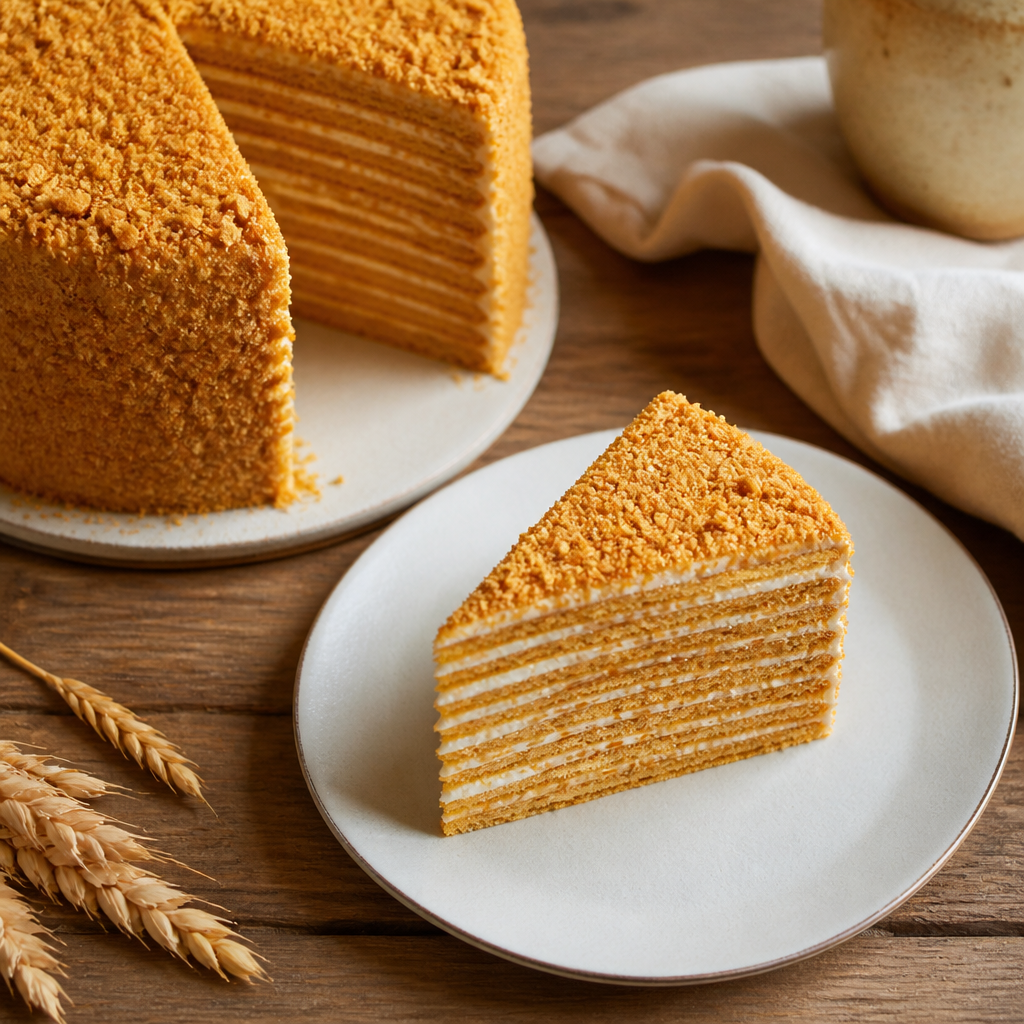
Classic Russian Honey Cake with Sour Cream Frosting
shared by Кухня Nibblore
Thin honey cake layers soften as they absorb the tangy sour cream frosting, developing a rich caramel aroma and tender texture. A coating of golden cake crumbs gives this Medovik its traditional homemade finish. Make it a day ahead so the layers can soften evenly and slice cleanly. • For a stable frosting, choose thick sour cream with no separated whey. If it is runny, drain it through cheesecloth in the refrigerator for 4–6 hours. • Roll the dough while it is warm, as cooled portions become firmer. If necessary, place a portion beside a warm baking tray for 1–2 minutes to soften it. • Do not overbake the layers: they firm up as they cool, and layers baked too dark may taste bitter. • The cake develops its final texture only after a long resting period, so do not shorten the chilling time to just a few hours. • Floral honey can be replaced with buckwheat honey, though the cake layers will have a noticeably deeper flavour and darker colour. • Instead of vanilla extract, use 10 g vanilla sugar and reduce the icing sugar to 140 g. • Sour cream with 25–30% fat can be replaced with drained 20% sour cream; after the whey has been removed, you will need 900 g of the thickened sour cream. Keep the Medovik covered in the refrigerator for up to 4 days. To freeze, cut the fully softened cake into portions, wrap them tightly and freeze for up to 1 month; thaw in the refrigerator for 8–10 hours. No reheating is needed.
- Total time
- 120 min
- Servings
- 12
- Difficulty
- Intermediate
Create a free account to keep this recipe in your own cookbook and find it again when it’s time to cook.
Save to my cookbook — freeIngredients
- 120 gfloral honey
- 140 ggranulated sugar
- 100 gunsalted butter, cubed
- 2large eggs
- 1 tspbaking soda, level
- ¼ tspfine salt
- 390 gplain flour, plus extra for rolling
- 900 gfull-fat sour cream, 25–30% fat and chilled
- 150 gicing sugar, sifted
- 1 tspvanilla extract
Instructions
- 1Prepare a bain-marie: pour 3–4 cm of water into a saucepan and bring it to a gentle simmer. Combine the honey, granulated sugar and butter in a heatproof bowl about 22 cm in diameter. Set the bowl over the saucepan without letting its base touch the water, then heat for 5–7 minutes, stirring until the butter and most of the sugar have dissolved.
- 2In a separate bowl, whisk the eggs with the salt just until smooth, without incorporating much air. Remove the honey mixture from the bain-marie and gradually pour in the eggs in a thin stream, whisking continuously. Return the bowl to the bain-marie and heat for 3 minutes, stirring constantly.
- 3Add the baking soda; the mixture will foam and expand. Continue heating for 2–3 minutes, stirring until the mixture turns amber. Remove the bowl from the heat and leave it for 5 minutes to cool slightly.
- 4Fold in 330 g of the flour with a spatula, then gradually add up to 60 g more. The dough should remain warm, soft and slightly sticky; do not make it stiff with excess flour. Shape it into a ball, cover and leave at room temperature for 20 minutes.
- 5Preheat the oven to 190°C using conventional top and bottom heat. Prepare two flat baking trays and sheets of baking parchment. Divide the dough into 9 equal pieces of about 95 g each, keeping them covered so their surfaces do not dry out.
- 6On lightly floured baking parchment, roll one piece of dough into a 2–3 mm-thick circle slightly larger than 20 cm in diameter. Prick it in several places with a fork. Bake one or two layers at a time, if the oven heats evenly, for 4–6 minutes until deep golden; roll out the remaining portions while the earlier layers bake.
- 7Immediately after removing each layer from the oven, while it is still soft, place a 20 cm cake ring or plate on top and trim around it with a knife. Transfer the round to a wire rack and reserve the trimmings. Roll and bake the remaining dough in the same way, then let all the layers cool completely for about 25 minutes.
- 8To make the frosting, combine the chilled sour cream, icing sugar and vanilla. Whisk for 1–2 minutes, only until the sugar dissolves and the mixture thickens slightly; prolonged whisking can make sour cream runny. Set aside 250 g of frosting for the top and sides.
- 9Place the first cake layer on a serving plate and spread it with about 80 g of frosting, stopping 5 mm short of the edge. Repeat with all the layers, gently pressing each new layer with your palm. Spread the reserved frosting over the top and sides of the cake.
- 10If the reserved cake trimmings are still soft, dry them in the oven at 160°C for 5–7 minutes. Let them cool, then crush them into fine crumbs. Coat the top and sides of the honey cake with the crumbs.
- 11Loosely cover the cake and refrigerate it for at least 8 hours, ideally 12 hours. Before serving, let the Medovik stand at room temperature for 20 minutes, then cut it with a clean, sharp knife.