
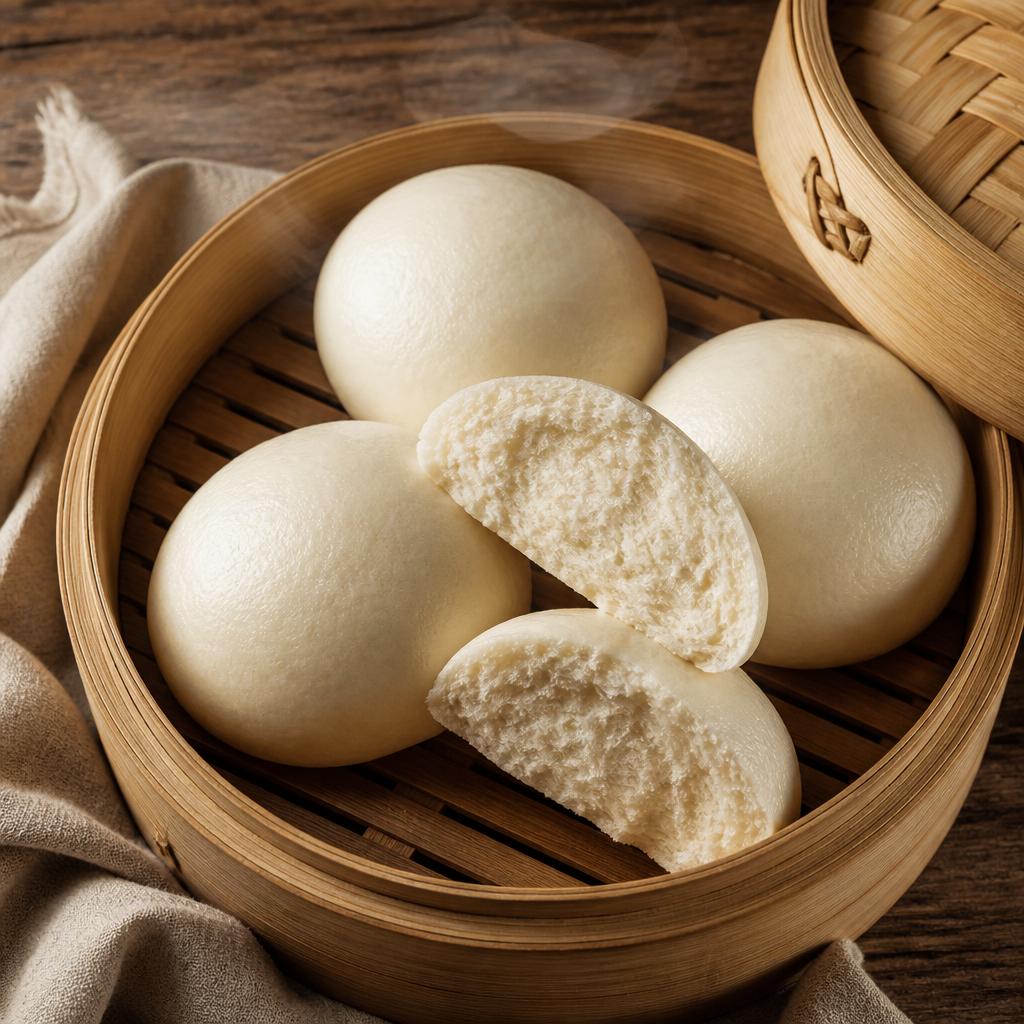
Chinese Steamed Buns: Soft Bao Recipe
shared by המטבח של Nibblore
These bao buns are pillowy, airy and gently sweet, making them ideal for both savoury and sweet fillings. Thorough kneading, two rises and a little oil create a supple texture that stays soft for longer. Serve them with a Chinese meal or fill them with vegetables, tofu or pulled meat. • Weighing the dough portions helps the buns steam evenly and finish cooking at the same time. • Wrap a metal steamer lid in a clean tea towel to stop condensation dripping onto the buns, tying the ends securely away from the flame. • Do not open the lid during steaming or immediately afterwards, as a sudden temperature change can make the bao shrink. • Replace the rice vinegar with the same amount of mild apple cider vinegar. • Use rapeseed, grapeseed or sunflower oil as the neutral oil. • If you do not have a stand mixer, knead by hand on a clean surface for 12–14 minutes, until smooth and elastic. Allow the buns to cool completely, then refrigerate in an airtight container for up to 3 days or freeze in a sealed freezer bag for up to 2 months. Steam refrigerated buns for 4–5 minutes, or steam directly from frozen for 8–10 minutes, until hot and soft in the centre.
- Total time
- 43 min
- Servings
- 10
- Difficulty
- Intermediate
Keep this recipe in your family cookbook — free forever.
Save recipeIngredients
- 300 gplain flour, plus extra for dusting
- 35 gcornflour
- 5 ginstant dried yeast
- 25 gwhite sugar
- 4 gbaking powder
- 3 gfine salt
- 185 mllukewarm water, 35–38°C
- 18 mlneutral vegetable oil, plus extra for greasing
- 2 tspunseasoned rice vinegar
Instructions
- 1Combine the plain flour, cornflour, yeast, sugar, baking powder and salt in the bowl of a stand mixer. Add the lukewarm water, oil and rice vinegar, then mix on low speed for 2 minutes, until no dry flour remains.
- 2Knead with the dough hook on medium-low speed for 8–10 minutes, until the dough is smooth, soft and elastic. It should pull away from the sides of the bowl while remaining slightly tacky underneath. If kneading by hand, knead for 12–14 minutes and add no more than 1 tablespoon of flour only if the dough is too sticky to handle.
- 3Shape the dough into a ball and place it in a lightly oiled bowl. Cover and leave to rise in a warm place for 60–75 minutes, until nearly doubled in size. Near the end of the rise, cut 10 squares of baking parchment measuring 8 × 8 cm.
- 4Transfer the dough to a lightly floured surface and press it gently to release large air bubbles. Divide it into 10 equal pieces, about 57 g each. Gather the edges of each piece into the centre, turn it seam-side down and roll beneath a cupped palm to form a smooth, taut ball.
- 5Place each ball on a square of baking parchment inside the steamer baskets, leaving at least 4 cm between the buns. Cover and prove for 25–35 minutes, until approximately half as large again and the dough springs back slowly when gently pressed with a finger.
- 6Fill a saucepan that fits the steamer with 4–5 cm of water, ensuring the water will not touch the basket. Bring to the boil over high heat, reduce to medium and place the covered steamer baskets over the pan.
- 7Steam the buns for 12 minutes without opening the lid. Turn off the heat, keep the lid closed for another 3 minutes, then open it gradually to prevent the buns from collapsing due to condensation and a sudden temperature change. The buns are ready when puffed, dry to the touch and springy when pressed.
- 8Transfer the bao, still on their parchment squares, to a wire rack. Cover with a clean tea towel and serve warm. If using one small steamer basket, cook the buns in two batches and keep the waiting batch covered in a cool place to prevent over-proving.