
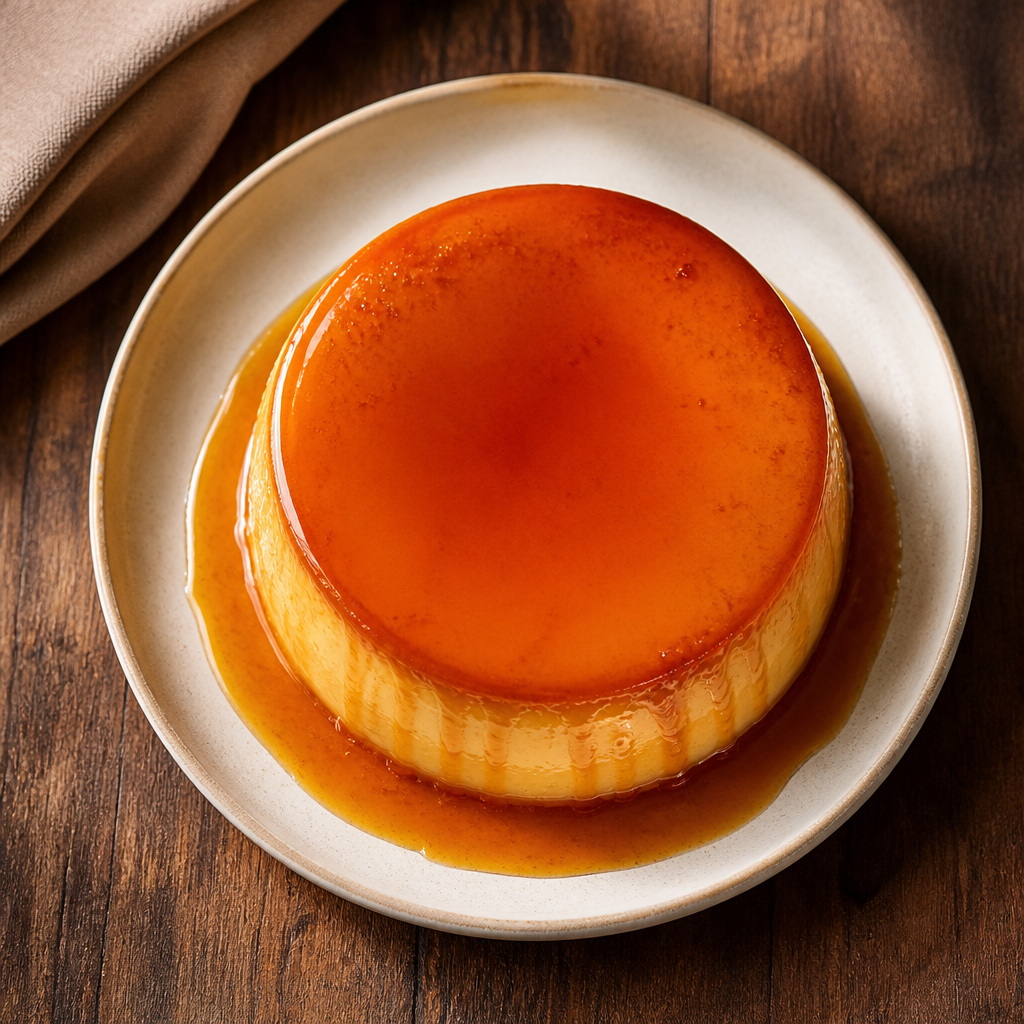
Classic Spanish Crème Caramel (Flan de Huevo)
shared by Nibblore Español
This classic Spanish flan is silky and creamy, with a delicate vanilla flavour and a glossy layer of liquid caramel. Gentle cooking in a water bath keeps the custard tender and helps prevent bubbles or a rubbery texture. It is an ideal make-ahead dessert because it needs several hours to chill before turning out. • Do not overwhisk the eggs: trapped air creates small holes instead of a smooth custard. • Remove the caramel from the heat when it turns amber, as the residual heat of the pan will continue to darken it. • Do not wait for the centre to become completely firm in the oven; it will finish setting as it cools. • Use a slightly deep serving plate to catch all the caramel when the flan is turned out. • Replace the vanilla extract with a wide strip of lemon zest, avoiding the white pith; steep it in the hot milk for 10 minutes, then remove it before mixing. • For a warmer flavour, steep a cinnamon stick in the hot milk for 10 minutes, then remove it before adding the milk to the eggs. • You can divide the mixture among 8 individual 120–150 ml flan moulds; bake them in a water bath for 30–38 minutes. Keep the flan covered in the fridge for up to 4 days. It is best stored in the mould and turned out shortly before serving. Freezing is not recommended because it may release water and lose its creamy texture after thawing; serve cold without reheating.
- Total time
- 75 min
- Servings
- 8
- Difficulty
- Intermediate
Create a free account to keep this recipe in your own cookbook and find it again when it’s time to cook.
Save to my cookbook — freeIngredients
- 150 ggranulated sugar, for the caramel
- 45 mlwater, for the caramel
- 500 mlwhole milk
- 5large eggs
- 100 ggranulated sugar, for the custard
- 1 tspvanilla extract
- 1 pinchfine salt
Instructions
- 1Preheat the oven to 160°C using conventional heat. Set an 18 cm round mould, about 7 cm deep, on a heatproof surface, and have a deep roasting tin ready that is large enough to hold the mould.
- 2Place the 150 g sugar and 45 ml water in a small saucepan. Heat over medium heat without stirring with a spoon; gently swirl the pan only if the colour is developing unevenly. Cook for 7–10 minutes, until the caramel is a deep amber colour but not dark brown.
- 3Immediately pour the caramel into the mould and, wearing oven gloves, tilt it to coat the base. Leave for 10 minutes, until hardened. Take care, as both the caramel and the mould will be extremely hot.
- 4Heat the milk in a saucepan over medium heat for 4–5 minutes, until steaming with small bubbles appearing around the edge, but do not let it boil. Remove from the heat and leave to stand for 5 minutes.
- 5Whisk the eggs, 100 g sugar, vanilla and salt in a large bowl for about 1 minute, just until combined; avoid creating too much foam. Gradually add the warm milk while stirring gently with a whisk.
- 6Strain the mixture through a fine-mesh sieve directly into the caramel-lined mould. Skim any foam from the surface with a spoon, then loosely cover the mould with foil.
- 7Place the mould inside the deep roasting tin. Pour freshly boiled water into the tin until it reaches about halfway up the sides of the mould. Bake for 45–55 minutes; the flan is ready when the edges are set and the centre wobbles like jelly when the mould is gently moved. If using a thermometer, the centre should reach 80–82°C.
- 8Remove the roasting tin from the oven and carefully lift the mould out of the water bath. Remove the foil, cool the flan on a wire rack for 45–60 minutes, then cover and refrigerate for at least 6 hours, preferably overnight.
- 9To turn out, run a thin knife around the edge without cutting deeply into the flan. Rest the base of the mould on a cloth soaked in hot water for 10–15 seconds, place a rimmed serving plate on top and invert both together in one firm movement. Lift off the mould and serve the flan cold with the liquid caramel.