
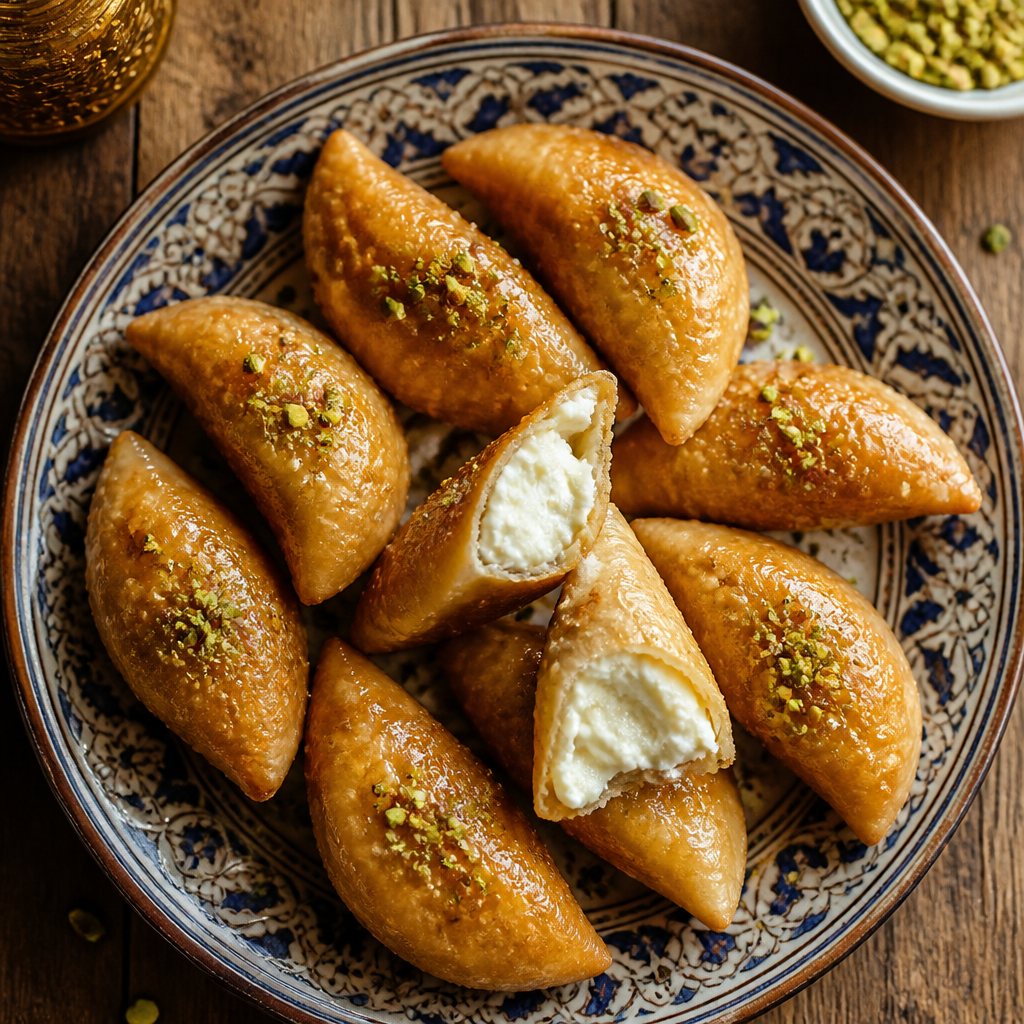
Qatayef with Ashta (Middle Eastern Cream-Filled Pancakes)
shared by مطبخ Nibblore
These soft, hole-speckled qatayef are filled with thick homemade ashta, then baked until golden with crisp edges and soaked in orange blossom syrup. Resting the batter and cooking each pancake on one side creates the signature bubbles while keeping it flexible enough to seal. Pouring cold syrup over the hot pastries gives them balanced sweetness without making them overly soft. • If the holes disappear or the surface stays wet for too long, thin the batter with 1 tablespoon water and slightly increase the skillet heat. • Cover the qatayef pancakes as soon as they leave the skillet; exposure to air dries the edges and makes them difficult to seal. • Make sure the ashta is cold and firm before filling, or it may leak during baking. • For the crispiest result, add a moderate amount of syrup immediately before serving and offer the rest separately. • Replace the orange blossom water with the same amount of rose water for a different floral aroma. • Replace the heavy cream with an equal amount of whole milk; the ashta will be lighter and less rich. • Use melted ghee instead of butter to brush the qatayef before baking. • Omit the pistachios or replace them with chopped walnuts, noting that this changes the allergen profile. Keep filled, unbaked qatayef covered in the refrigerator for up to 24 hours, or freeze them on a tray before transferring to an airtight container for up to 1 month. Bake from frozen, adding 5–7 minutes to the baking time. Refrigerate baked qatayef without syrup for up to 2 days, then reheat at 190°C for 6–8 minutes before adding syrup. Syrup-soaked qatayef also keep for 2 days but will lose some crispness.
- Total time
- 80 min
- Servings
- 16
- Difficulty
- Intermediate
Create a free account to keep this recipe in your own cookbook and find it again when it’s time to cook.
Save to my cookbook — freeIngredients
- 300 ggranulated sugar, for the syrup
- 180 mlwater, for the syrup
- 1 tsplemon juice, freshly squeezed
- 1 tsporange blossom water
- 500 mlwhole milk, for the ashta
- 120 mlheavy cream
- 45 gcornstarch
- 25 ggranulated sugar, for the ashta
- 1 tsporange blossom water, for the ashta
- 190 gall-purpose flour
- 35 gfine semolina
- 12 ggranulated sugar, for the batter
- 1 tspinstant yeast
- 1 tspbaking powder
- ¼ tspfine salt
- 390 mlwater, lukewarm at 38°C
- 45 gunsalted butter, melted for browning
- 15 gpistachios, finely chopped for garnish
Instructions
- 1Make the syrup first: Combine 300 g sugar and 180 ml water in a small saucepan, stirring over medium heat only until the sugar dissolves. Bring to a boil and cook without stirring for 7 minutes, then add the lemon juice and boil for 2 more minutes. Remove from the heat, stir in 1 teaspoon orange blossom water, and cool completely to room temperature.
- 2Make the ashta: Whisk the cornstarch and 25 g sugar with 100 ml of the cold milk in a medium saucepan until completely smooth. Add the remaining milk and the heavy cream, then cook over medium heat, whisking continuously for 7–9 minutes, until the mixture gently boils and thickens enough for the whisk to leave a distinct trail.
- 3Remove the ashta from the heat and stir in 1 teaspoon orange blossom water. Transfer it to a wide dish, press plastic wrap directly onto the surface, and refrigerate for 25 minutes, until firm enough to use as a filling without running.
- 4Combine the flour, semolina, 12 g sugar, yeast, baking powder, and salt in a large bowl. Gradually whisk in the lukewarm water until the batter is smooth and pourable, with the consistency of light cream. Cover and leave in a warm place for 20 minutes, until small bubbles appear on the surface; stir gently once before cooking.
- 5Heat a heavy-based nonstick skillet over medium heat for 3 minutes. Pour about 2 tablespoons batter per pancake to form a 9 cm round, cooking two or three at a time on one side only for 60–90 seconds. Each pancake is ready when the top is completely dry and covered with holes while the underside is pale golden.
- 6Transfer the cooked pancakes to a clean kitchen towel with the hole-speckled side facing up, then cover with a second towel to keep them pliable. Repeat with the remaining batter, adjusting the heat if the bottoms brown before the tops dry. Let the pancakes cool for 10 minutes before filling.
- 7Preheat the oven to 220°C, or 200°C fan, and line a 30 × 40 cm baking tray with baking paper. Place about 1 heaped tablespoon of ashta in the centre of the cooked side of each pancake, fold into a half-moon, and firmly pinch the edges together from end to end to seal completely.
- 8Arrange the qatayef in a single layer on the prepared tray and brush both sides of each piece with melted butter. Bake for 12–15 minutes, turning after 8 minutes, until deep golden and crisp around the edges.
- 9Immediately transfer the hot qatayef to a rimmed serving dish and pour over 180–220 ml of the cold syrup, depending on your preferred sweetness. Leave for 5 minutes to absorb, then garnish with pistachios and serve warm with extra syrup on the side.